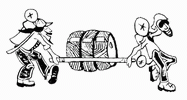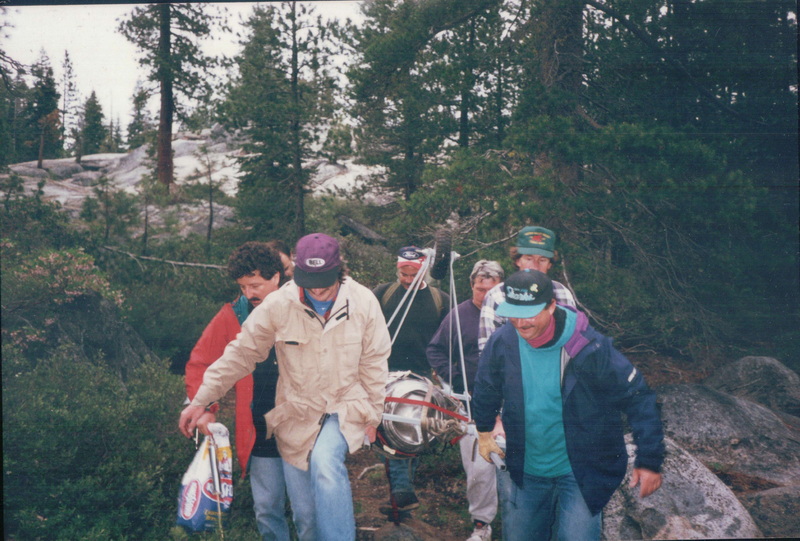
A standard full-size keg — a half-barrel — weighs 160 pounds full. The empty keg alone is about 30 pounds; the remaining 130 is pure beer. It holds 15.5 gallons: roughly 165 twelve-ounce cans, 124 pints, or 14 cases. There is no road to the campsite. There is no trail the whole way. The keg goes in on a stretcher, carried by four to six people with reliever teams rotating in.
Over 50 years, the stretcher has been redesigned — and re-redesigned — more than once.
Generation 1: The Wood Stretcher
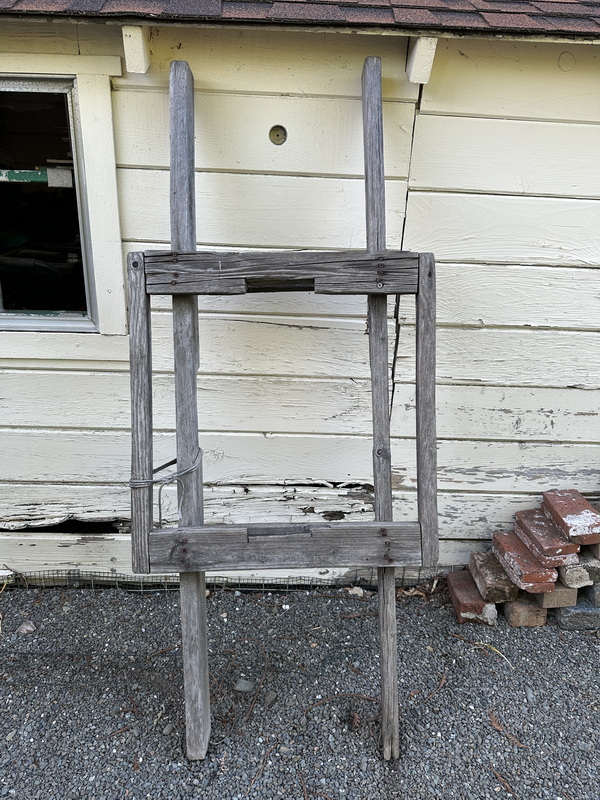
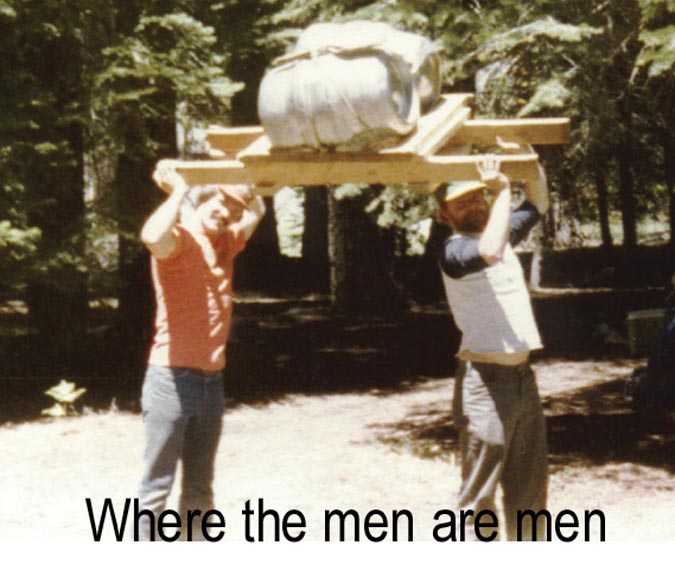
The first stretcher was built from 2"×4" lumber at Tom McGonigle's dad's shop in 1976, for the very first Kegger. Two poles, cross-braced, keg strapped in the middle. Simple, heavy, and effective.
Several were built over the years. They were hard on the wood — the keg is heavy, the terrain is rough, and lateral loads on a wooden frame in Sierra granite country are unforgiving. If you have ever seen a full keg slip from the hands of six people and tumble down a hill, you understand why backups were needed.
The wood design served for roughly 20 years. The one photographed here still lives in someone's garage — a 50-year-old piece of Kegger history made of weathered Douglas fir.
Generation 2: The Steel Stretcher
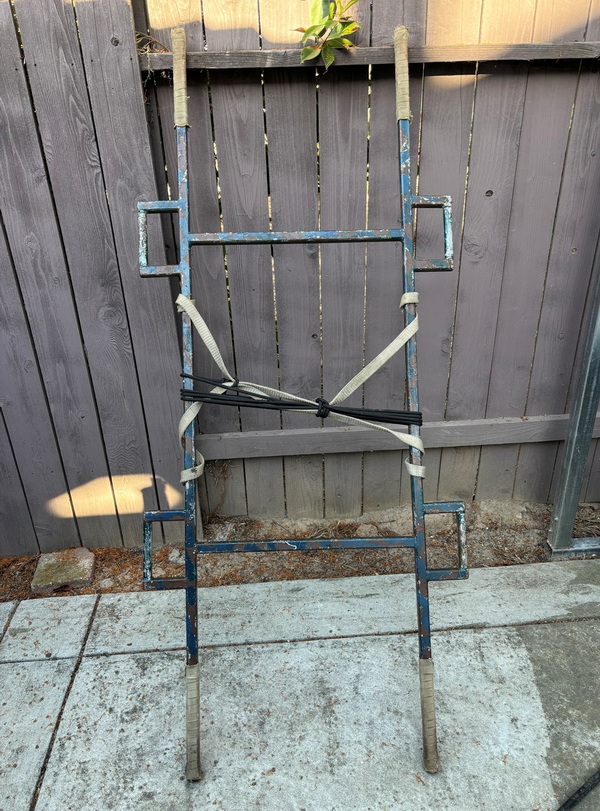
In the early 1990s, Tom commissioned a proper steel stretcher. Ed W. designed and built it: welded square steel tubing — 1"×1"×.120 wall — with cylindrical round-tube cross-members at the carry points. The handles are rope-wrapped. It was painted blue.
It weighs more than the wood version. This is not ideal when you are already carrying a 160-pound keg. But it does not flex, does not split, and does not let the keg slide off granite the way 2×4 lumber sometimes did.
Philip Webster later drew up precise engineering specifications — dimensions, material specs, and handle detail — to document the design for posterity. Total: 31" wide × 72" tall × 1" thick.
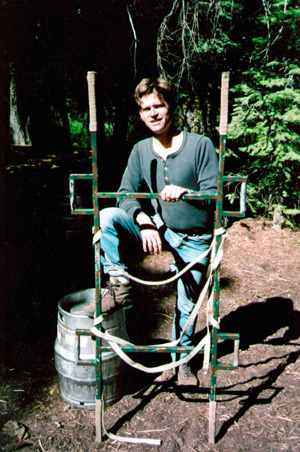
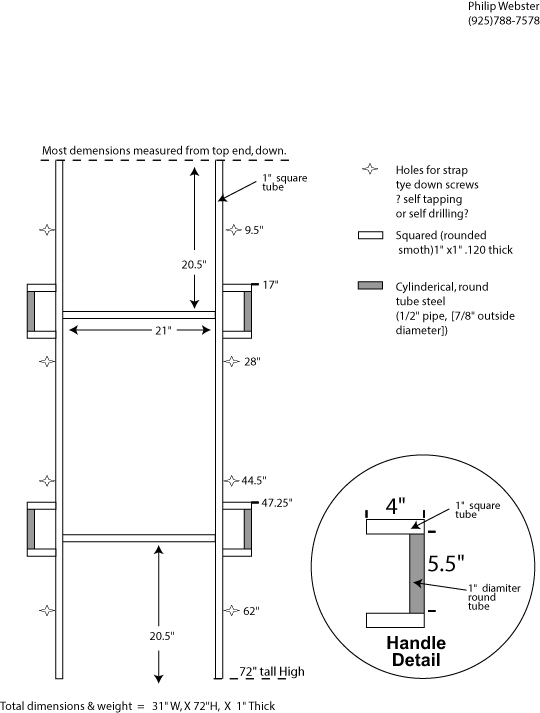
Steel stretcher specifications — per Philip Webster
- Main rails: 1" square tube, rounded smooth, 1"×1" × .120 wall
- Cross-members: cylindrical round tube steel, ½" pipe (⅞" OD)
- Carry-bar spacing: 9.5", 17", 28", 44.5", 47.25" from top
- Handle detail: 4" wide × 5.5" tall — square outer, round inner grip
- Total: 31"W × 72"H × 1" thick
- Strap tie-down holes at multiple points along rails
Generation 3: The Wheely
The most ambitious stretcher redesign was "the Wheely" — a white PVC-framed stretcher with a wheel in the center, designed to roll the keg across flat terrain rather than requiring six people to carry it the whole way. In theory: brilliant. In practice: the Stanislaus backcountry does not have flat terrain.
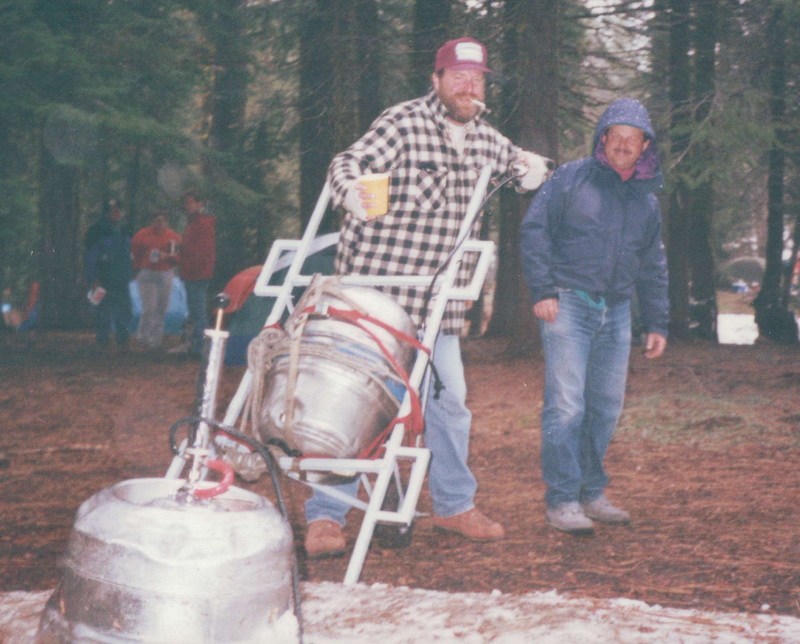
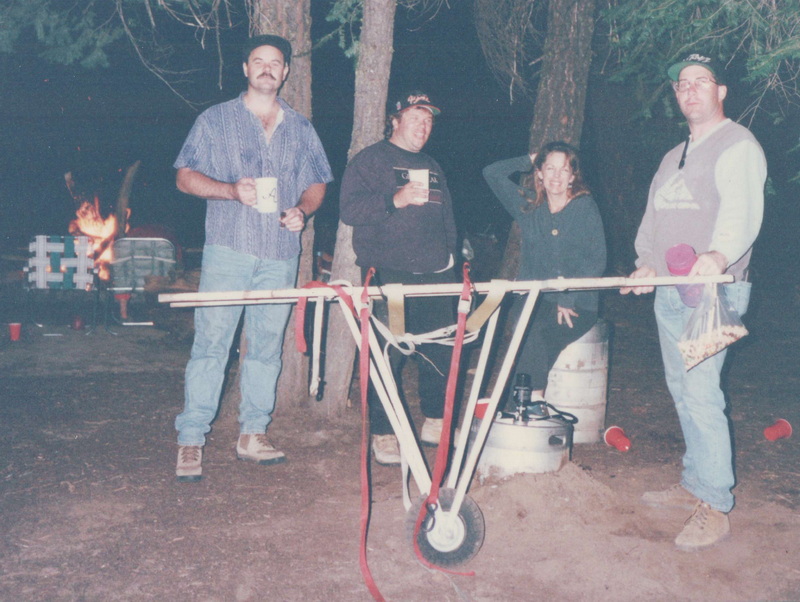
The wheel stretcher — lessons learned
The route from trailhead to the Island is not a road. It involves granite slabs, boulder fields, grassy hillsides, muddy creek crossings, and at least one stretch where the whole team has to think carefully about hand placement before taking a step.
In those conditions, a wheel that rolls helpfully on pavement becomes an obstacle when the ground tilts 30 degrees. The wheel digs in, catches on rocks, and requires someone dedicated to lifting it over obstacles — which means one fewer person actually carrying the keg.
The Wheely was used and is still the current stretcher. But the wheel has been mostly symbolic. The old carry method — four to six people, rotating teams, slow and steady — remains the answer after 50 years.
See also: The Kegs → for the history of which beers have made the trip.